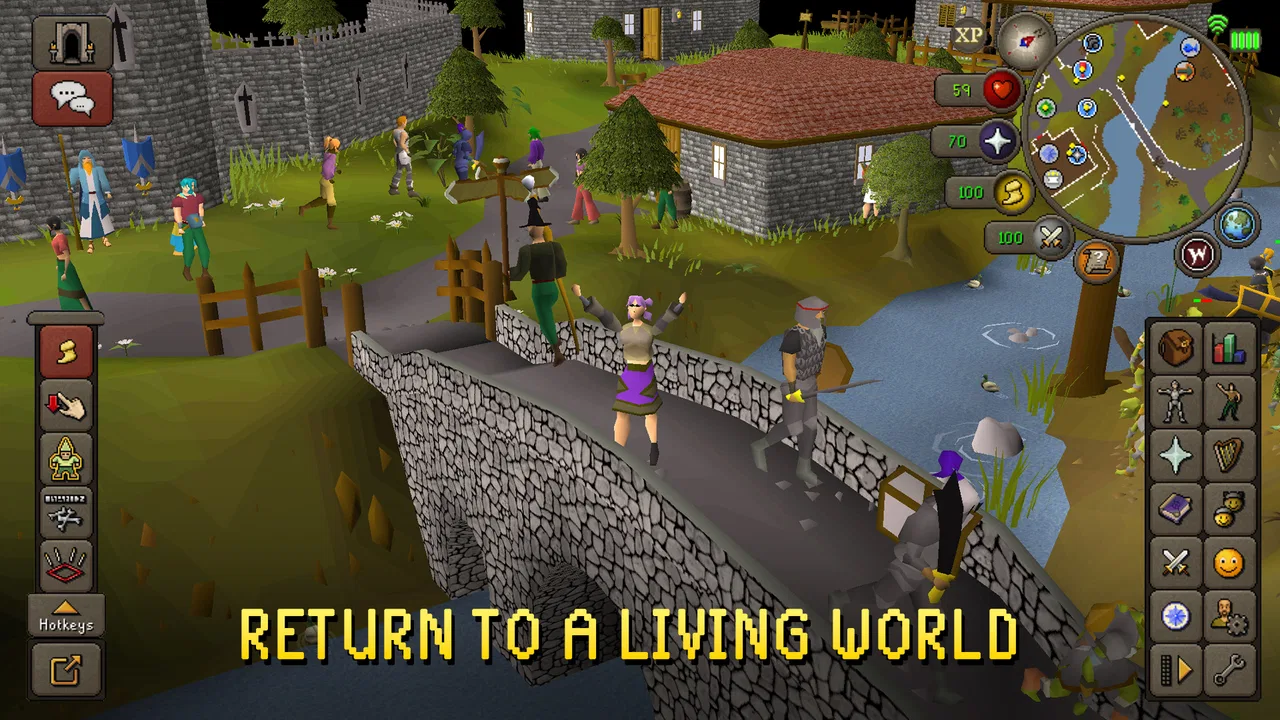
Old School RuneScape
- 4.1
- Rating
- 5.00M
- Installs
- Free
- Price

 Analysis by App-foxy
Old School RuneScape is the kind of adventure game I return to when I want progress to feel personal rather than automatic. Its defining strength is the freedom to decide what “progress” means: I can follow a quest, improve a skill, explore a dangerous area, fight other players, or simply work toward a long-term goal that I created for myself. That open-ended structure is also the reason it will not suit everyone. If you prefer a guided mobile RPG with quick rewards and a clear finish line, this can feel slow and demanding. If you enjoy building an account at your own pace, its old-fashioned design becomes surprisingly compelling.
Developed by Jagex Games Studio, this free adventure game brings the Old School RuneScape experience to Android and iOS. It has a Teen age rating, supports devices running Android 8.0 or later, and its current version is 236.1. The game has passed five million installs, with an average rating of 4.1 from roughly 134 thousand ratings and about 26 thousand written reviews. Those figures suggest a large, active audience, but they do not remove the learning curve. I still had to spend time understanding the economy, equipment choices, skill training and travel before the world began to feel comfortable.
Freedom is the real feature
I like how this game leaves room for goals beyond simply moving to the next quest. In my experience, choosing one small target before I log in—such as preparing for a journey or deciding what kind of progress I want today—keeps the freedom from turning into aimless wandering. That sense of ownership is the starting point; the next thing worth considering is how progress becomes visible over time.
You May Also Like

 Blood Strike: 2.5 Anniversary
Blood Strike’s Loadouts Turn Every Drop Into a Tactical Gamble
A close look at Blood Strike’s custom loadouts: how fast access to signature weapons reshapes its battle royale rhythm, rewards preparation, and narrows the gap between fights.

 Pandora - Music & Podcasts
Pandora’s Music Is Easy to Start, but Harder to Recover
Pandora’s strength is its low-effort path from a seed to a station. Its weak spot is how much confidence it asks you to place in connection, setup, and quiet recovery.

 8 Ball Pool
 Is Built on Rivalries, Rematches, and Routine
A close look at the rivalries, rematches, shared routines, and unanswered safety questions that turn a quick pool match into a persistent mobile community.

 Samsung Music
’s Quiet Strength Is Playing What You Already Own
Its reach comes less from spectacle than from dependable access to a personal library. That simplicity is both the app’s strongest retention engine and its ceiling.

 AccuWeather: Weather Radar
AccuWeather Review: A Quick, Clear Forecast for Everyday Decisions
For everyday plans, the best forecast is the one you can understand quickly. AccuWeather makes rain timing, radar, and local conditions easy to act on, with a few trade-offs.

 Hill Climb Racing
Why Hill Climb Racing Still Turns Crashes Into One More Run
A tiny car, a bumpy hill and one more upgrade: Hill Climb Racing keeps resurfacing because its simple chaos makes every near-miss feel personal.
More From Our News Desk



A character built around choices, not a fixed class
The capability that matters most here is the open-ended character system. Rather than locking me into a single class with a narrow role, the game lets me develop different skills and decide how my account should function. That changes the experience from “complete the next mission” to “choose the kind of player I want to become.” One person may focus on combat, another may spend more time gathering and producing useful items, while someone else may treat quests and exploration as the main attraction.
This freedom has a practical effect on mobile play. I do not need to wait for a specific group, build my character around a current trend, or abandon a favorite activity because it is not the most efficient route. I can log in with a small objective, such as collecting materials or finishing a nearby task, and still feel that the session moved my account forward. The best part is that progress remains meaningful even when I am not following the fastest possible path.
That design also makes the world feel more like a sandbox than a conventional theme-park RPG. Quests introduce stories, places and challenges, but they do not completely dictate my schedule. The game’s fantasy setting supports both player-versus-environment encounters and player-versus-player battles, so the same account can gradually become useful in very different situations.
Why the old-school design still works
The presentation and structure are deliberately traditional. This is not a glossy mobile game built around constant visual effects or a short sequence of guided battles. The interface can feel dense at first, and the amount of information surrounding equipment, inventory, skills and travel may seem intimidating on a phone. However, the simpler visual style helps the game communicate its systems clearly once I understand the basics.
I also appreciate that the game gives me room to make inefficient choices without making the account feel ruined. Early mistakes are part of learning how the world works. I may carry the wrong supplies, choose an awkward route or spend time training something that does not immediately help my current goal. Those decisions are mildly frustrating, but they also make later knowledge valuable. I begin to remember which preparation saves time, which tasks are worth combining and when it is smarter to leave an area than risk losing progress.
The trade-off is that the game rarely feels instantly rewarding. Many mobile alternatives compress progression into short missions, automatic movement and frequent upgrade screens. Old School RuneScape asks me to pay attention and accept repetition. That patience is not a side issue; it is central to whether the game feels satisfying or tedious.
How the open world works during a normal session
In practice, I usually start a session with one clear intention rather than trying to do everything. I might choose a quest, prepare for combat, improve a skill or gather resources. The world then gives me several ways to approach that intention. I can travel directly, stop to handle a nearby activity, adjust my equipment, or change plans after discovering that the area is more dangerous than expected.
That flexibility is especially useful on a phone. A short session can be devoted to a contained task, while a longer evening can be used for a quest chain or a more involved preparation routine. The important point is to set a realistic target before opening the game. Without one, I can spend too much time moving between activities and finish the session unsure whether I actually achieved anything.
I found the interface easier to manage when I treated the screen as a set of deliberate controls rather than trying to rush every action. Tapping through menus quickly is tempting, but a moment spent checking equipment and supplies often prevents a much longer interruption later. This is one of the game’s less obvious mobile lessons: careful preparation matters more than fast tapping.
The best everyday scenario for mobile play
The strongest use case is a player who has a few spare moments during the day and a longer period available later. For example, I can use a short break to organize inventory, travel toward a destination or work on a simple skill. When I have more time at home, I can continue with a quest, explore a new area or prepare for a harder fight. The same character supports both types of session without forcing me to restart with a separate mobile-friendly mode.
This works because the game’s progress is not limited to one repeated match format. I am not waiting for a full team to become available before my account can advance. I can play alone for much of my routine, then choose to engage with more dangerous content or player-versus-player activity when I am ready. That makes the game more accommodating than many multiplayer adventures that are built around constant matchmaking.
There is a practical warning, though. A phone session is not automatically casual just because the game is on mobile. Some objectives require attention, travel planning and sensible preparation. I would not begin an unfamiliar dangerous activity while distracted or with only a minute available. The game is flexible about when I play, but it does not always simplify what I am doing.
Quests feel better when used as landmarks
Quests are a useful way to give structure to the open world. When I feel lost, choosing one provides a destination and a reason to visit places I might otherwise ignore. I like using quests as landmarks rather than treating them as a checklist that must be cleared as quickly as possible. They introduce a sense of discovery while still letting me pause and develop my character when a challenge exposes a weakness.
A helpful habit is to prepare before starting a quest instead of repeatedly returning to town for forgotten supplies or equipment. I check what the objective seems to demand, make sure I have room for anything I may collect, and avoid carrying unnecessary items. This sounds basic, but it saves a surprising amount of time in a game where travel and preparation are part of the experience.
The downside is that the game does not always explain its world in the direct, modern way I expect from newer mobile adventures. I sometimes need to read carefully, remember a location or experiment with an approach. Players who dislike looking for solutions or retracing their steps may find this less welcoming than a heavily guided RPG.
Combat rewards preparation more than reflexes
Combat is not simply about tapping an attack button until an enemy disappears. Equipment, positioning, supplies and the choice of opponent all influence whether an encounter feels manageable. I learned to treat preparation as part of the fight itself. Arriving with the wrong setup can turn a routine battle into an expensive interruption, while a modest amount of planning can make the same challenge feel controlled.
This is also where the open-ended system creates useful trade-offs. A character developed for one activity may not be ideal for another, so I cannot assume that general progress automatically makes every encounter easy. That encourages me to understand what I am preparing for instead of relying on a single universal setup.
Player-versus-player battles add another layer of tension. They can make the world feel less predictable and give experienced players a demanding goal, but they are not the best starting point for someone still learning movement, equipment and risk. I would first become comfortable with ordinary exploration and combat before deliberately seeking competitive encounters.
Where the game pushes back
The largest limitation is time. Progress can require patience, and some activities are intentionally repetitive. I do not recommend this game to someone looking for a quick burst of action with a clear reward after every few minutes. The slower rhythm is part of its identity, but it can feel like work if I approach it with the expectations of a modern idle game.
The interface is another hurdle. On a larger screen, information is easier to scan, while on a phone I sometimes need extra taps to inspect items, switch equipment or manage an inventory. The mobile version makes the world accessible away from a computer, but it does not turn the underlying game into a simplified touchscreen experience. Players with smaller displays or limited patience for menus should try a short session before committing to a long-term character.
There is also a social and economic learning curve. Understanding what to keep, sell, use or save is not immediately obvious, especially when the inventory is full and several activities compete for the same space. I recommend resisting the urge to discard unfamiliar items just to create room. A little organization and a habit of checking an item before selling it can prevent avoidable frustration.
The game is free to download, but it includes in-app purchases priced from $7.49 to $131.88 per item. That is important for anyone planning to spend money, particularly because the highest listed purchase is substantial. I would begin without buying anything, learn whether the slower progression suits me, and only then decide whether spending improves my personal experience. The free entry point is useful, but it should not be confused with a completely cost-free long-term commitment for every player.
How it compares with more guided mobile RPGs
Compared with a typical mobile adventure that emphasizes automatic combat, frequent character upgrades and short missions, Old School RuneScape gives me more control and less convenience. I make more decisions, but I also perform more of the routine work. That makes it a better choice when I want ownership over my route and development, not when I want the game to handle most of the journey for me.
It also differs from session-based multiplayer games. A match-focused title can deliver a complete experience in a predictable block of time, while this game treats each login as part of a continuing world. That persistence is rewarding because small actions accumulate, but it can make stopping feel less tidy. I sometimes finish a session in the middle of a plan rather than at a neat victory screen.
For players comparing it with other fantasy role-playing games, the key question is not whether it has the newest graphics or the fastest combat. It is whether a long-running sandbox with quests, exploration, skill development, environmental battles and competitive danger sounds appealing. If the answer is yes, its older presentation becomes easier to accept. If the answer is no, a more guided alternative will probably be more enjoyable from the first hour.
Who gets the most from the open-ended structure
I think this game is best for patient players who enjoy setting their own targets. It suits someone who likes gradually improving an account, learning an economy, planning equipment and returning to a world that does not reset after one match. It is also a good fit for people who want both solitary activities and the option of competitive encounters without being forced into one style from the beginning.
It is less suitable for players who need immediate direction, dislike repetition or want a story that carries them from one cinematic moment to the next. It may also frustrate anyone who expects every mobile game to support one-handed, low-attention play. Although I can make progress in short sessions, some goals demand concentration and preparation.
New players should begin with modest objectives. I would learn the interface, keep the inventory organized, follow a few quests for orientation and avoid treating efficiency guides as mandatory rules. Once the basic rhythm becomes familiar, I would choose one long-term aim and let other activities support it. That approach makes the freedom feel useful instead of overwhelming.
My final view after settling into its rhythm
Old School RuneScape succeeds because its central capability is not a single combat trick or visual feature. It is the ability to shape a character through decisions that remain yours. The game trusts me to choose a direction, make mistakes and gradually understand the consequences. That trust creates a deeper connection than the instant rewards offered by many mobile RPGs, but it also asks for more patience than most newcomers expect.
With a 4.1 average and a large player base, it is clearly not a niche experiment, yet popularity should not hide its demanding design. I recommend it to anyone who wants a genuine fantasy sandbox on mobile and is willing to learn its systems at an unhurried pace. I would skip it in favor of a more guided alternative if my priority were fast matches, automatic progression or a polished, constantly directed presentation.
For me, the deciding factor is the feeling that a small choice can become part of a much larger personal journey. I can play for a few minutes, return later and continue building toward a goal that matters because I chose it. If you want a mobile adventure where your patience, planning and curiosity shape the experience, this is still a remarkably distinctive choice.
FAQs for Old School RuneScape
01What is Old School RuneScape and how does it differ from the modern version?
Old School RuneScape (OSRS) is a revival of the 2007 version of the popular MMORPG RuneScape. It offers a nostalgic experience with traditional graphics and gameplay. Unlike the modern RuneScape, OSRS sticks to its roots with fewer updates and changes, focusing on community-driven improvements and classic mechanics.
02Is Old School RuneScape free to play, and what are the benefits of membership?
Old School RuneScape offers a free-to-play version with limited access to content. Membership provides numerous benefits, including access to more quests, skills, and areas, as well as exclusive items and a larger in-game community. Players can purchase membership with real money or in-game bonds.
03Can I play Old School RuneScape on both Android and iOS devices?
Yes, Old School RuneScape is available on both Android and iOS platforms. The mobile version offers the full game experience, allowing players to seamlessly switch between desktop and mobile. Ensure your device meets the minimum system requirements for optimal performance and gameplay.
04How does the in-game economy work in Old School RuneScape?
The in-game economy in OSRS is player-driven, with items bought and sold through the Grand Exchange or direct trades. Prices fluctuate based on supply and demand, with some items used for quests, skills, and combat. Players can earn gold by gathering resources, crafting, or completing tasks.
05What are the main activities and skills available in Old School RuneScape?
Old School RuneScape features a variety of skills and activities, including combat, crafting, fishing, woodcutting, and more. Players can engage in quests, player-vs-player combat, and mini-games. Each skill offers unique challenges and rewards, contributing to character progression and customization.
Pros
- Authentic nostalgic experience
- Cross-platform play available
- Regular content updates
- Engaging community events
- Skill-based progression system
Cons
- Dated graphics for new players
- Slow-paced gameplay for some
- Requires internet connection
- Complexity can be overwhelming
- Subscription needed for full access

Old School RuneScape
Gallery